
Yangon for women travelling alone
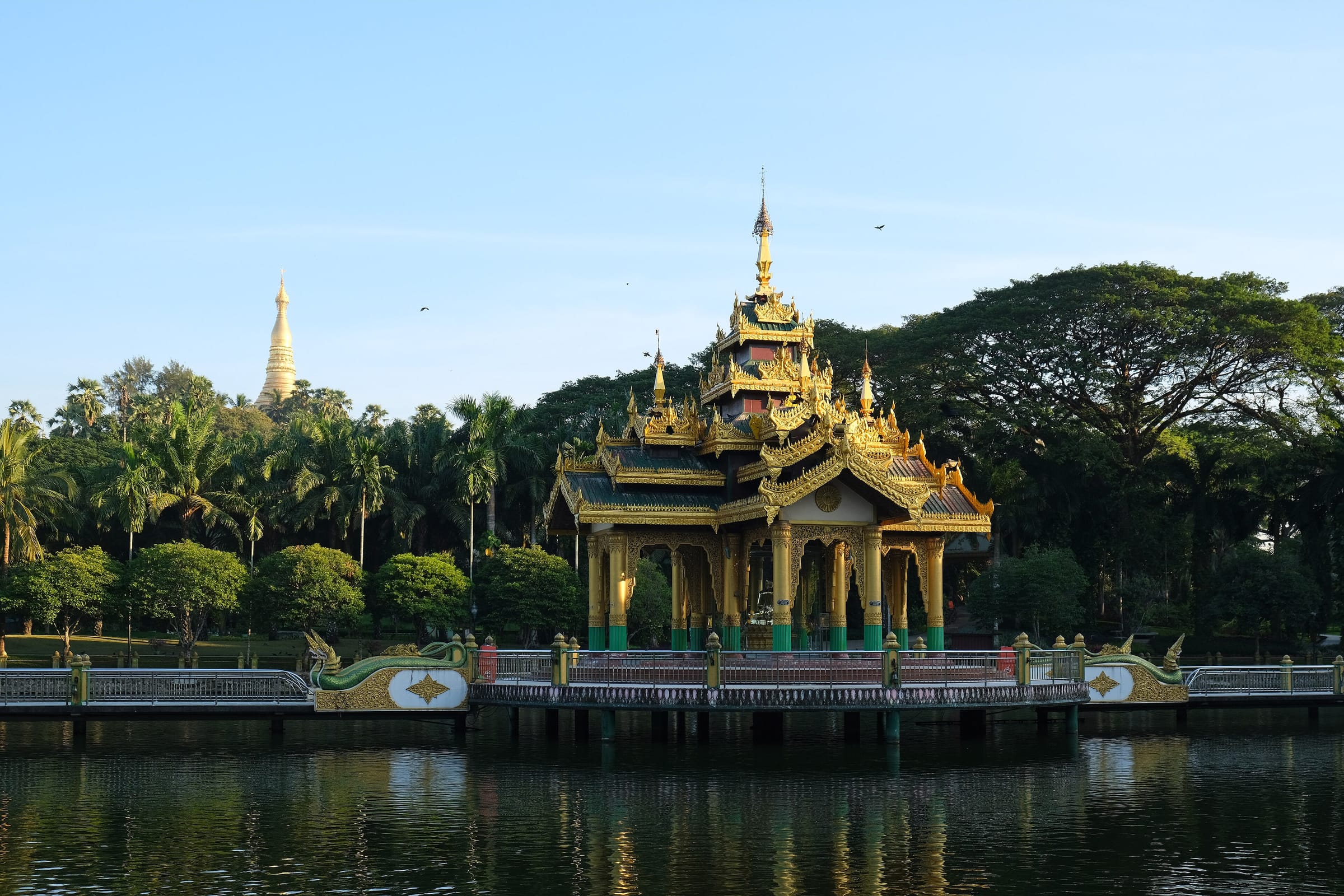
Colonial architecture and Shwedagon Pagoda
- Budget
- $30 a day
- On foot
- Walkable
- Getting around
- Good
- Best months
- November to February
- First solo trip
- expert
- Wifi
- poor
- English
- Moderate
- Places to stay
- 8+ read
01 of 10
The read
Yangon rewards women who arrive informed: the politics are real, and the city itself is entirely workable.
What holds up
- City centre is a compact colonial grid, walkable between most sights in under 30 minutes.
- Grab, the ride-hailing app used across Southeast Asia, operates in Yangon with fixed fares and GPS tracking.
- Solo women are received with curiosity and courtesy; 19th Street's open-air BBQ scene is one of the most naturally social spots in the region.
What to weigh
- Myanmar carries a Level 4 Do Not Travel advisory from the US and equivalent warnings from Australia, UK, and Canada as of mid-2026; check your own government's current advice and buy evacuation insurance before you go.
- Power cuts in Yangon are frequent and extended; social media is blocked and many VPNs have been restricted, so install a reliable VPN before you leave home and carry cash for your entire stay.
Yangon is loud, humid, and full of character. The Shwedagon Pagoda at sunset is the landmark, and the circular train, a three-hour loop, is the best way to see how the city actually lives. City centre is walkable and arranged on a grid, so orientation comes quickly.
Solo dining is easy here. The teashops are social hubs where sitting alone is completely normal. Try the mohinga, a fish noodle soup, at any street stall. For something air-conditioned, the restaurants around Inya Lake and Kabar Aye Pagoda Road offer international menus.
ATMs are available but carry extra USD as backup. The political situation is complex and evolving, so check current advisories before booking. Yangon is a working city rather than a tourist one. City centre empties out after dark. Grab is the way to get around at night. Most guesthouses in the city centre area are within walking distance of the major sights.
02 of 10
Who this suits
Yangon suits travellers who are comfortable with infrastructure gaps, power outages, and places where English is limited beyond tourist areas. If you find meaning in sitting in a tea shop for an hour watching nothing in particular happen, this city has a lot to give you.
03 of 10
Common questions
What people ask about Yangon, answered with specifics rather than in general terms.
- Do I need a visa to enter Myanmar?
- Most nationalities require a visa. The e-visa system has been intermittently available since the 2021 coup; check the current status with Myanmar's immigration portal before booking. Some nationalities have visa-on-arrival arrangements, but these also change without notice.
- Can I use credit cards in Yangon?
- Rarely and unreliably. Most restaurants, guesthouses, and markets are cash-only. Carry enough kyat for each day. Some higher-end hotels accept cards but may add a surcharge. ATMs in the city centre Yangon work for foreign cards, though daily limits apply.
- What do I need to know before visiting Shwedagon Pagoda?
- There is an entrance fee for foreigners, collected at the elevator entrances. You remove shoes at the base and walk the marble platform barefoot. Shoulders and knees must be covered; longyis are available to rent at the entrance if needed. The pagoda faces all four cardinal directions, each entrance equally valid.
- Is it easy to get a local SIM card?
- Yes. Ooredoo and MPT both sell SIM cards at Yangon International Airport on arrival. Bring your passport. Data packages are inexpensive and activate quickly. Having a local SIM is worth it for Grab and Google Maps navigation.
- What's the current travel advisory situation?
- Since the February 2021 military coup, most Western governments maintain heightened travel advisories for Myanmar. Yangon has been less directly affected by conflict than border regions, but the political situation is unstable. Read your government's current advisory in full before booking.
- What should I wear day-to-day in Yangon?
- Lightweight, loose clothing that covers knees is practical both for the heat and for entering temples or pagodas without scrambling for a cover-up. A longyi, the traditional sarong worn by men and women across Myanmar, can be bought cheaply at Bogyoke Market and works well as a temple cover.
04 of 10
Where to stay
Each of these has been read rather than listed. The full set is on the stays page.
- WYNDHAM GRAND YANGON Hotel
City centre, with two restaurants, spa, gym and outdoor pool; check-in from 2pm.
hotel · 4.5 from 1506 reviews - Vintage Luxury Yacht Hotelhotel · 4.1 from 967 reviews · about $45 a night
- Governor's Residencehotel · 4.6 from 488 reviews · about $125 a night
- Hotel Bondhotel · 3.9 from 178 reviews
- HOOD HOSTEL
Solo women consistently mention the staff as the standout reason to stay here. Help with SIM cards and currency exchange makes arrival in Yangon noticeably easier. The reviews are too thin to confirm a specific downside.
hostel · 4.3 from 176 reviews - Scott Hostelhostel · 4.4 from 167 reviews
- The Link Yangon Boutique Hotel
Quiet residential streets near Inya Lake, with bars, restaurants and a mall close by.
hotel · 4.1 from 165 reviews - The Loft Hotel
Features multiple outdoor spaces including a garden, restaurant patio.
hotel · 4.2 from 157 reviews
05 of 10
What to know
- 01
Shwedagon Pagoda etiquette
The most sacred Buddhist site in Myanmar. Remove shoes before the entrance stairways (not just at the top). Dress modestly: shoulders and knees covered. Walk clockwise around the stupa. Photography is allowed but be respectful around people praying. Sunset and nighttime visits are spectacular.
- 02
19th Street is the social centre
Chinatown's 19th Street fills with plastic chairs and beer stations every evening. It is the most reliably social spot in Yangon. Sitting alone is completely fine and conversations with neighboring tables happen naturally. The BBQ skewers are the standard order.
- 03
Tea shop culture
Tea shops (laphet yay zain) are Myanmar's social institution. They serve sweet milk tea, mohinga, samosas, and snacks. Sitting in a tea shop for an hour watching the street is a genuine cultural experience. Some tea shops have been in the same location for decades.
- 04
Colonial architecture is crumbling and reviving
City centre Yangon has one of the largest collections of colonial buildings in Southeast Asia. Some are being restored (the Secretariat, Strand Hotel), others are in serious decay. The Yangon Heritage Trust offers guided walks that explain the history and preservation efforts.
- 05
Longyi is the local dress
Both men and women in Yangon wear longyi (wrapped skirt). Buying one at Bogyoke Market or a fabric shop and wearing it to temples is practical and appreciated. Shopkeepers will show you how to tie it.
06 of 10
Getting around
- 01
Walking city centre is best
The colonial grid from Sule Pagoda south to the river is compact and walkable. Most city centre attractions, restaurants, and colonial buildings are within a 30-minute walk of each other. Pavements are uneven and sometimes blocked.
- 02
Grab works in Yangon
Grab operates in Yangon and is the most reliable way to get to Shwedagon, Kandawgyi Lake, and areas outside city centre. Taxis are also available but Grab provides fixed pricing and GPS navigation.
- 03
Circular Railway for local experience
The Yangon Circular Railway is a 3-hour loop through the city and suburbs. It is slow, crowded, and gives a window into daily Yangon life. The full loop is an experience in itself. Trains run roughly every 40 minutes.
- 04
Getting around wider Yangon
Buses are available but routes are confusing for visitors. Grab or taxi is more practical for Inya Lake, the airport (45-60 minutes from city centre), and outlying areas. Rush hour traffic is heavy.
07 of 10
How the day runs
Shwedagon Pagoda at sunrise is the essential Yangon experience. The morning light on the gold is extraordinary. Downtown colonial walks work well before the heat: Strand Hotel, Secretariat Building, Sule Pagoda circuit. Bogyoke Aung San Market opens at 9am for gems, textiles, and crafts. Tea shops open at dawn and serve mohinga (fish noodle soup), the national breakfast.
Shwedagon requires covered shoulders and knees and bare feet. The marble platform gets hot after 10am.
The heat peaks. Yangon Heritage Trust walking routes cover the colonial architecture. The National Museum has Burmese art and royal artifacts. Kandawgyi Lake park and boardwalk offer a green escape. Air-conditioned malls (Junction City, Sule Square) provide refuge.
The Secretariat Building (where Aung San was assassinated) has recently opened for tours. Worth booking in advance.
19th Street in Chinatown is Yangon's outdoor beer and BBQ street. Plastic chairs, grilled skewers, and draft Myanmar Beer define the experience. Shwedagon lit up at night is stunning. The Strand Bar has colonial-era cocktails. Inya Lake area has quieter dinner options.
19th Street is the most social evening experience in Yangon. It is completely normal to sit at a table alone and you will likely end up talking to neighbors.
08 of 10
What to eat
- 01
Mohinga
Myanmar's national dish: rice vermicelli in a thick, catfish-based broth with banana stem, lemongrass, and crispy fritters on top.
Lucky Seven Tea Shop on Anawrahta Road. Any busy mohinga stall before 9am will be excellent.
- 02
Shan Noodles
Flat rice noodles with chicken or pork in a light tomato-based sauce, topped with roasted peanuts and pickled mustard greens.
999 Shan Noodle Shop on 34th Street. Simple, consistently good, always packed.
- 03
Lahpet Thoke
Fermented tea leaf salad mixed with crunchy beans, toasted sesame, fried garlic, tomato, and cabbage. Totally unique to Myanmar.
Any tea shop or restaurant. It's served as a snack with green tea. Try the version at Rangoon Tea House on Pansodan Street.
- 04
Samosa Salad
Crushed samosas tossed with chickpeas, onions, cilantro, and a tangy tamarind-chili dressing. Indian influence, Burmese execution.
Street stalls near Sule Pagoda, or the food stalls at Bogyoke Aung San Market.
09 of 10
Neighbourhoods
- 01
The city centre (Colonial Core)
The grid of streets between Sule Pagoda and the Yangon River holds the densest concentration of colonial-era buildings in Southeast Asia. Mahabandoola Garden, the Strand, the old Secretariat building, and the Botahtaung Pagoda are all walkable from each other.
Best for Walking, architecture, street food, and the 19th Streetbar strip after dark. - 02
Sanchaung
A residential township northwest of the city centre where local coffee shops, bookstores, and noodle shops outnumber tourist-facing businesses. Streets have pavements, low foot traffic by Yangon standards, and a genuinely neighbourhood feel.
Best for Finding a regular tea shop, eating where no menu exists in English, and staying somewhere quieter than the city centre. - 03
Kamayut
Adjacent to the Inya Lake area and closer to the universities, Kamayut has a concentration of international hotels alongside local restaurants that cater to Yangon's middle class. Pyay Road runs through it with frequent bus options.
Best for Mid-range hotels with reliable generators and air conditioning, and access to Inya Lake. - 04
Bahan
Bahan sits between Shwedagon Pagoda and Inya Lake, with wide streets lined with embassies and large residences. The pagoda's southern entrance opens directly into this township.
Best for Staying close to Shwedagon so you can visit at sunrise or sunset without a long commute. - 05
Chinatown (Latha)
Latha, immediately west of Sule Pagoda, runs into the Chinatown blocks around Mahar Bandula and Shwedagon Pagoda roads. The night market on Anawrahta Road runs until late, and the streets have consistent foot traffic through the evening.
Best for Street food, night market browsing, and tea shops that stay open past midnight.
10 of 10
Local knowledge
The operational detail that is obvious once you are there and impossible to guess before.
- The kyat exchange rate fluctuates significantly; check parallel market rates before exchanging money, as official rates diverge sharply.
- Power outages are normal across the city; always check that your hotel has a generator before booking.
- Bogyoke Market vendors will often start high on lacquerware; it's expected that you'll negotiate, not rude to do so.
- Mohinga (fish noodle soup) is a breakfast food in Yangon, not dinner; go to a tea shop early if you want the fresh version.
- The pagoda platform at Shwedagon is entirely barefoot; bring a bag to carry your shoes rather than checking them if you plan to photograph freely.
- Street-facing restaurants in Chinatown set up plastic chairs on the footpath; sitting in the street is normal and not a problem.
- Many ATMs in central Yangon have daily withdrawal limits and sometimes run out of kyat entirely; withdraw when you can, not when you must.