
Osaka for women travelling alone
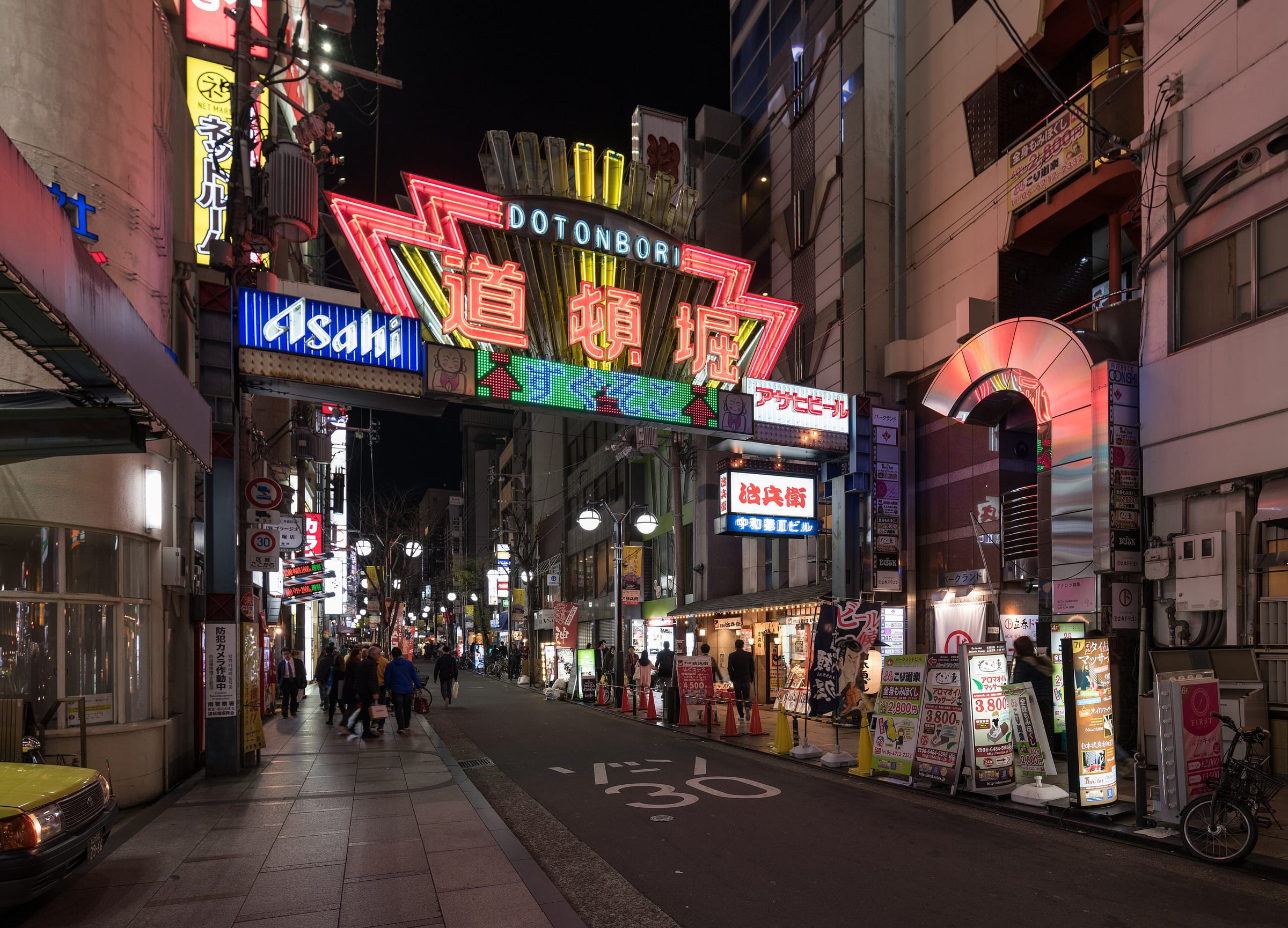
Street food capital with neon and nightlife
- Budget
- $60 a day
- On foot
- very walkable
- Getting around
- Excellent
- Best months
- March to May, September to November
- First solo trip
- Good first trip
- Wifi
- Excellent
- English
- low
- Places to stay
- 8+ read
01 of 08
The read
Osaka rewards solo women immediately: the city is outgoing, the food is extraordinary, and the transport runs itself.
What holds up
- Subway stations are signed in English and trains run every 3, 5 minutes; one IC card (a rechargeable prepaid travel card) covers every line.
- The core of the city, from Namba through Dotonbori to Shinsaibashi, is walkable within 15 minutes in any direction.
- Osakans talk to strangers, and eating or drinking alone draws zero attention.
What to weigh
- English is genuinely low here, more so than Tokyo; have your accommodation address saved in Japanese before you arrive.
- July and August bring intense heat and humidity; spring and autumn are far more comfortable for walking.
Osaka is where Japan loosens its collar. The food scene alone justifies the trip: takoyaki from street carts, okonomiyaki cooked in front of you, and some of the best ramen in the country at hole-in-the-wall spots throughout Namba and Shinsekai.
Dotonbori is the neon-lit centre of everything, but staying one stop away in Shinsaibashi or Namba gives you walkable access without the tourist markup. Clean business hotels are the standard option. The metro is simple, well-signed, and covers the whole city. A day pass covers the subway.
Osaka has a reputation for being friendlier and more outgoing than Tokyo, and it is true. People are more likely to strike up conversation, especially in standing bars (tachinomi) where solo drinking is completely standard. Osaka is orderly at all hours, and the subway runs late. Day trip options are excellent: Nara (45 minutes, deer park and giant Buddha), Kobe (30 minutes, waterfront and beef), and Himeji Castle (one hour) are all easy solo excursions by train.
02 of 08
Common questions
What people ask about Osaka, answered with specifics rather than in general terms.
- Is Osaka a good place to travel alone?
- Osaka is one of the easier places in the region to travel alone for the first time. Subway stations are signed in English and trains run every 3, 5 minutes; one IC card (a rechargeable prepaid travel card) covers every line.
- How much does Osaka cost a day?
- Around $60 a day covers a bed, food and local transport for one person in Osaka.
- How do you get around Osaka?
- Subway is fast and simple. Two main lines (Midosuji and Chuo) cover most areas. Trains run every 3-5 minutes during the day. Umeda to Namba is 10 minutes. IC cards work on all lines. Stations are well-signed in English.
- When is the best time to visit Osaka?
- March to May, September to November is the window most travellers aim for in Osaka. July and August bring intense heat and humidity; spring and autumn are far more comfortable for walking.
- Where should you stay in Osaka on your own?
- Distances in Osaka are larger than they look on a map, so the area you pick matters more than the property. Street food capital with neon and nightlife
03 of 08
Where to stay
Each of these has been read rather than listed. The full set is on the stays page.
- The Ritz-Carlton, Osaka
Four restaurants, a spa and a cigar bar, with bay views and 2pm check-in.
hotel · 4.4 from 5204 reviews - Sauna & Capsule Amzahostel · 4.1 from 2082 reviews
- Centara Grand Hotel Osaka
Some rooms experience noise from nearby train tracks.
hotel · 4.5 from 1385 reviews · about $235 a night - The Lively Osaka Honmachi
Front desk staffed 24 hours, check in from 2pm, in a business district near the subway.
hotel · 4.3 from 969 reviews · about $150 a night - Namba Guesthouse HIVE
An elevator from the station leads straight to the entrance, with check in from 2pm.
homestay · 4.7 from 714 reviews - & AND HOSTEL SHINSAIBASHI EASThostel · 4.6 from 697 reviews
- COGO TENNOJI
Located 6-minute walk from Tennoji Station.
hotel · 4.6 from 565 reviews - Mitsuwaya
Features a shared guest kitchen where travellers can prepare their own meals.
hotel · 4.7 from 297 reviews
04 of 08
What to know
- 01
Osaka people talk to strangers
Unlike Tokyo, random friendly conversation from locals is normal here, especially at counter-seat restaurants and standing bars. This is cultural, not suspicious. Osakans are famously outgoing.
- 02
Dotonbori is a spectacle, not a food destination
The main Dotonbori strip is for photos and atmosphere. The best food is one or two streets back, or in neighbourhoods like Ura-Namba, Tenma, and Fukushima. Locals rarely eat on the main drag.
- 03
Shinsekai looks rough but is fine
The area around Tsutenkaku Tower has a gritty aesthetic and older demographic. It is one of the best street food areas in the city. The vending machine alleys and retro game centers add to the character.
- 04
Women-only train cars exist
Morning rush hour trains have designated women-only cars, marked with pink signs on the platform. They operate roughly 7:30-9:00am on weekdays. Outside those hours, all cars are mixed.
05 of 08
Getting around
- 01
Subway is fast and simple
Two main lines (Midosuji and Chuo) cover most areas. Trains run every 3-5 minutes during the day. Umeda to Namba is 10 minutes. IC cards work on all lines. Stations are well-signed in English.
- 02
Walking works in core areas
Namba, Dotonbori, Shinsaibashi, and Amerikamura are all within a 15-minute walk of each other. Umeda is a separate cluster that requires a train. The underground shopping passages connect major stations and are useful in rain.
- 03
JR lines for day trips
JR Osaka Station (Umeda) connects to Kyoto (30 min), Kobe (20 min), and Nara (45 min via Yamatoji line). Private railways (Kintetsu, Nankai, Hankyu) also run regional routes from different terminals.
- 04
Cycling is underrated
Flat city with bike lanes on major streets. Many hostels and guesthouses lend bicycles. Riding along the Yodo River path is a local favourite.
06 of 08
How the day runs
Osaka starts slower than Tokyo. Kuromon Market opens around 8am and is best before 10am when tour groups arrive. Coffee culture is growing, with specialty shops concentrated in Nakazakicho and Horie. Osaka Castle park is popular for morning runs.
Many restaurants do not open until 11am or later. Konbini breakfast is reliable.
Street food peaks in Dotonbori and Shinsekai. Amerikamura (Ame-Mura) is the vintage shopping district. Den Den Town is the electronics and otaku district. Afternoon is a good window for Osaka Castle or the Sumiyoshi Taisha shrine before crowds thin.
Shinsekai is rougher-looking but perfectly fine during the day. Kushikatsu (deep-fried skewers) originated here.
The city comes alive. Dotonbori neon reflects off the canal. Izakayas in Ura-Namba (backstreet Namba) are packed with locals. Shinsaibashi shopping arcade stays open late. Craft beer bars in Amerikamura draw an international crowd.
Standing bars (tachinomi) are a great solo option and are popular with office workers after 6pm.
Namba and Shinsaibashi stay active past midnight. Karaoke chains are open 24 hours and solo karaoke (hitokara) is a real thing with dedicated booths. Late-night ramen shops cluster around station exits. The last train is around midnight.
Missing the last train is common. Manga cafes (manga kissa) offer reclining seats and showers for an overnight stay.
07 of 08
What to eat
- 01
Takoyaki
Golden ball-shaped batter filled with diced octopus, pickled ginger, and green onion. Crispy outside, molten inside. Osaka's street food icon.
Wanaka in Namba, or the stalls around Dotonbori. Watch them spin the balls with picks.
- 02
Okonomiyaki
Savoury cabbage pancake loaded with your choice of seafood, pork, or cheese, topped with sweet sauce, mayo, bonito flakes, and nori.
Mizuno on Dotonbori (there will be a queue) or Kiji in Umeda Sky Building basement.
- 03
Kushikatsu
Deep-fried skewers of meat, seafood, and vegetables in a light panko crust. Rule: never double-dip in the communal sauce.
Shinsekai district. Daruma is the famous chain, but any busy spot in the area delivers.
- 04
Gyoza
Pan-fried pork and garlic dumplings with crispy bottoms. Osaka does them with a thinner skin and more garlic than anywhere else.
Chao Chao Gyoza in Shinsaibashi, or Horai 551 for the steamed version.
- 05
Kitsune Udon
Thick, chewy udon noodles in a sweet-savoury dashi broth topped with a large piece of sweet fried tofu. Osaka comfort food.
Usami Tei Matsubaya near Namba. Serving udon since 1893.