
Malacca for women travelling alone
Colonial port town with Peranakan heritage
- Budget
- $30 a day
- On foot
- very walkable
- Getting around
- Good
- Best months
- December to February
- First solo trip
- Good first trip
- Wifi
- Good
- English
- Expensive
- Places to stay
- 8+ read
01 of 09
The read
Malacca is one of the most beginner-friendly solo trips in Southeast Asia: compact, English-speaking, and endlessly good to eat.
What holds up
- English is widely spoken throughout the heritage area, in guesthouses, cafes, and markets.
- The entire UNESCO zone is flat and walkable; most women stay on foot all day and use Grab, Southeast Asia's ride-hailing app, for anything beyond it.
- The heritage shophouse guesthouses put you at the centre of everything, with other travellers easy to meet.
What to weigh
- The famous Jonker Street night market runs on Fridays and Saturdays only; arriving mid-week means a quieter, calmer street, which is fine but different.
- Malacca is hot and humid year-round, with heat peaking in the early afternoon; the city rewards early mornings and evenings, not midday marches.
Malacca (Melaka) is a compact historic city on Malaysia's west coast, about two hours south of KL by bus. The UNESCO-listed centre is small enough to cover on foot in a day: Jonker Street is the main drag, lined with antique shops, cafes, and restaurants that transform into a night market on Friday and Saturday evenings. The Dutch Square with its red church and clocktower marks the colonial core.
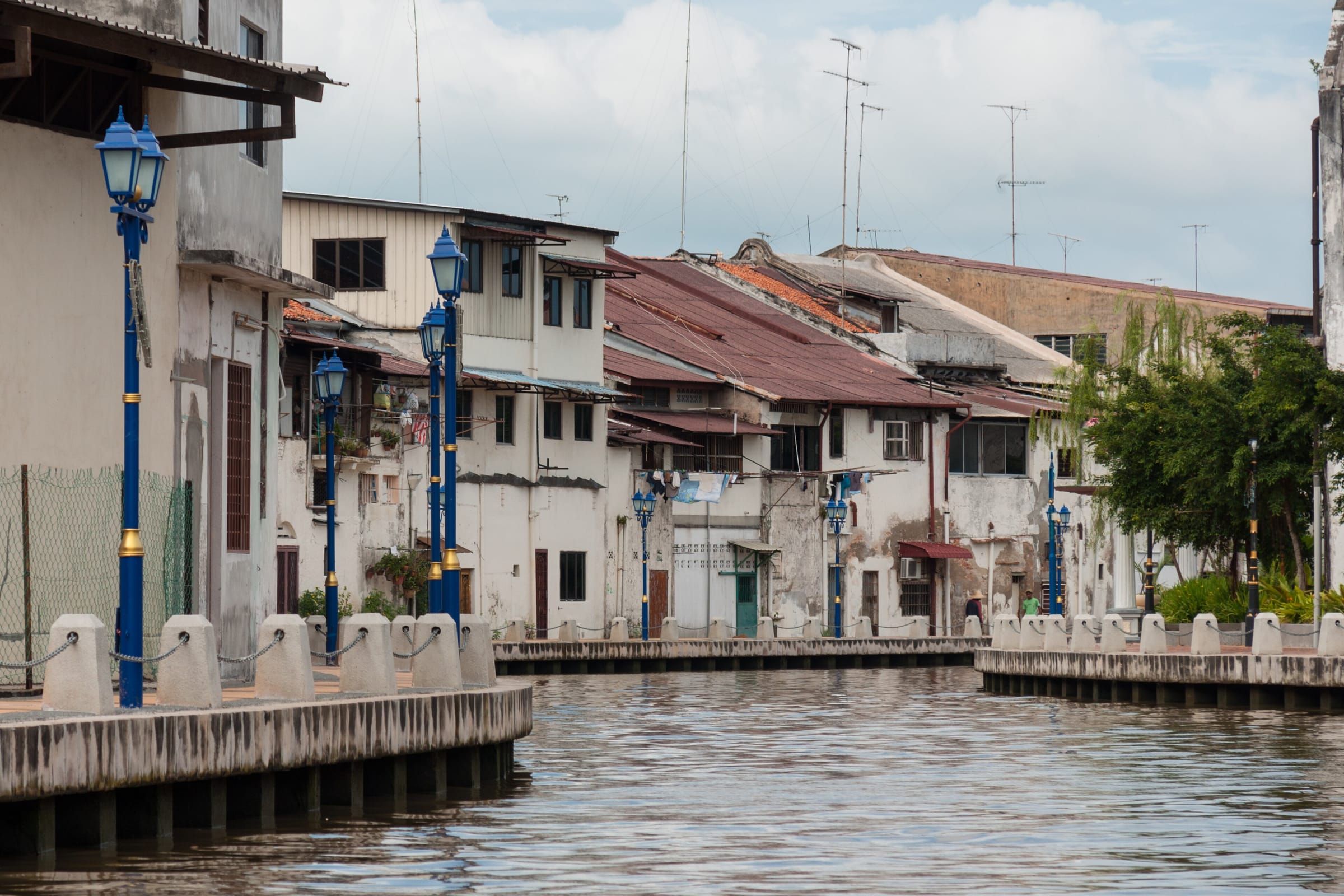
The Peranakan (Straits Chinese) heritage gives Malacca its distinctive character. The Baba Nyonya Heritage Museum is worth a visit for understanding the culture, and the food reflects the fusion: try chicken rice balls, cendol, and nyonya laksa from the hawker stalls. A river cruise along the Malacca River passes street art murals and old godowns.
Malacca is small and easy. The historic centre takes an afternoon to walk. The historic centre is walkable, well-lit, and tourist-friendly. Most visitors come as a day trip from KL, but staying one night lets you catch the Jonker Street night market and the riverfront lit up after dark. It's a slower, more heritage-focused stop compared to Penang or KL.
02 of 09
Who this suits
Malacca works well for a solo traveller who wants history and food without the logistics of a large city. It suits someone who moves slowly, eats often, and doesn't need a beach or a rooftop bar to feel like they're having a good trip.
03 of 09
Common questions
What people ask about Malacca, answered with specifics rather than in general terms.
- How long does Malacca take to see properly?
- Two full days covers the main sights without rushing. Three days lets you eat your way through the city more thoroughly and take a half-day trip somewhere outside the centre.
- Is Malacca worth visiting as a day trip from KL?
- The bus takes about two hours each way on a good day. You lose four hours to travel and arrive mid-morning, which means competing with day-tripper crowds. Staying one or two nights gives you the city before and after those crowds, which is a different experience entirely.
- What should I know about getting from the bus terminal to the historic centre?
- Malacca Sentral is not walkable to Jonker Street. Grab is the straightforward option and takes about fifteen minutes. Local buses exist but routes are infrequent and complicated for a first visit with luggage.
- Can I get around Malacca without speaking Malay?
- Yes. English is widely spoken in the historic centre, guesthouses, and restaurants. Away from the tourist areas it's patchier, but Grab removes most language friction for transport.
- What's the dress code consideration for visiting temples and mosques here?
- Kampung Kling Mosque and the Sri Poyyatha Vinayagar Moorthi Temple both require covered shoulders and knees. Sarongs are available at the mosque entrance if you arrive in shorts. Lighter temples along Jonker Street are less strict but covering shoulders is standard practise.
- What's the best way to handle cash versus cards in Malacca?
- The night market and older kopitiams run on cash. Larger restaurants and hotels take cards. Withdraw a reasonable amount when you arrive because ATMs inside the historic core are sparse, and the nearest bank branch cluster is outside the pedestrian area.
04 of 09
Where to stay
Each of these has been read rather than listed. The full set is on the stays page.
- Casa del Rio Melaka
Features rooftop infinity pool with city views and on-site spa services.
hotel · 4.7 from 3465 reviews - Rosa Malacca
Solo women mention good security and a cafe worth eating in alone. The hotel sits within walking distance of Jonker Walk, which helps at night. Reviews are thin, so deeper specifics on staff hours or room noise are hard to confirm.
hotel · 4.5 from 1666 reviews · about $71 a night - Sojourn Spa Hotel Melaka
Solo women mention staff who are attentive and genuinely calm to be around. The rooms are consistently described as clean and comfortable. Reviews are thin on specific solo-travel details, so harder to say more than that.
hotel · 4.6 from 1118 reviews - Liu Men Hotel Melaka
Solo women consistently mention staff who are attentive and warm from the moment of arrival. The rooms are described as clean and quiet, with comfortable beds and good showers. The reviews are thin on recurring caveats, so no specific downside stands out.
hotel · 4.8 from 630 reviews - Rucksack Inn Premium Melakahotel · 4.3 from 606 reviews
- TheBlanc Boutique Hotelhotel · 4.4 from 353 reviews
- Yote 28Women only
The kitchen is described as having great facilities.
hostel · 4.7 from 293 reviews - Ringo's Foyer Guest House
Rooftop terrace near Jonker Street, reception open 9am to midnight, check-in from 2pm.
homestay · 4.5 from 274 reviews
05 of 09
What to know
- 01
Jonker Street night market is Friday and Saturday only
The famous night market runs from about 6pm to midnight on Friday and Saturday evenings. The street fills completely with food, shopping, and entertainment. Sunday through Thursday, Jonker Street is open but without the night market atmosphere.
- 02
The Baba Nyonya heritage is unique to Malacca
Peranakan (Baba Nyonya) culture, a blend of Chinese and Malay traditions, is central to Malacca's identity. The Baba Nyonya Heritage Museum is a restored family home that explains this culture. The Nyonya cuisine is found here in its most authentic form.
- 03
One full day covers the main sights
The heritage area is compact enough that you can see the key historical sites, walk the river, and explore Jonker Street in a single day. Adding a second day gives time for the food scene and the Portuguese Settlement neighbourhood.
- 04
Book accommodation near Jonker Street
Staying within walking distance of Jonker Street puts you at the centre of everything. The heritage shophouse guesthouses along Jalan Tun Tan Cheng Lock and Jalan Hang Jebat are the most atmospheric options.
06 of 09
Getting around
- 01
The heritage core is walkable
From Jonker Street to the Dutch Square to St. Paul's Hill is a 15-minute walk. The entire UNESCO zone can be covered on foot in a morning. Streets are flat and mostly pedestrian-friendly in the old town.
- 02
Grab for anything outside the core
Melaka Sentral bus station, the malls, and neighbourhoods outside the heritage zone require Grab or taxi. Rides are short because the city is small.
- 03
Decorated trishaws are everywhere
The flower-and-music-covered trishaws are Malacca's signature transport. They do tourist loops around the heritage area. Agree on the route and fare before boarding. They are more of an experience than practical transport.
- 04
Buses from KL are frequent
Buses from KL's TBS terminal to Melaka Sentral run every 30-60 minutes and take about 2 hours. From Melaka Sentral, it is a 15-minute Grab ride to Jonker Street.
07 of 09
How the day runs
Heritage walk, churches, museums
The historical zone is best explored in the morning before the heat peaks. St. Paul's Church, A Famosa fort ruins, and the Baba Nyonya Heritage Museum open early. Breakfast at a kopitiam on Jonker Street sets the day.
River cruise, cafes, galleries
The Malacca River cruise runs 45-minute loops past the street art murals. The heritage area has small museums and galleries in converted shophouses. Air-conditioned cafes along the river are good for the hottest hours.
Jonker Street night market (weekends), dinner
Friday and Saturday nights, Jonker Street closes to traffic and fills with food stalls, trinket vendors, and live music. On weeknights, the riverside restaurants and Jonker Street shops are still open but calmer. Satay celup (communal hot pot with satay sticks) is the local dinner tradition.
08 of 09
Neighbourhoods
- 01
Jonker Street (Chinatown)
This is the historic centre. The main strip, Jalan Hang Jebat, runs through restored shophouses converted into cafés, antique shops, and guesthouses. On Friday and Saturday nights a street market takes over, and foot traffic stays high until around 11pm.
Best for First-timers, food seekers, and anyone who wants to be within walking distance of most major sights. - 02
Bukit China
A quiet residential hill that holds one of the oldest Chinese cemeteries outside China. The streets around the base have a handful of local kopitiam coffee shops and the Sam Poh Kong temple at the foot of the hill. It's a five-minute tuk-tuk ride from Jonker Street.
Best for A quieter morning away from the tourist centre, with strong local coffee and minimal crowds before 9am. - 03
Portuguese Settlement (Ujong Pasir)
About four kilometres from the historic core, this coastal neighbourhood is home to Malacca's Eurasian-Portuguese community. The square has a few restaurants serving Devil's Curry and grilled seafood, and the area is quieter than Chinatown by a significant margin.
Best for Dinner at a table with actual locals around, and a look at a side of Malaccan history most day-trippers skip. - 04
Kampung Morten
A Malay village that survived on the banks of the Malacca River, right against the edge of the tourist district. Traditional wooden stilted houses sit alongside community gardens, and you can cross a narrow footbridge from the river walk to reach it. Villa Sentosa, a Malay heritage house, offers informal tours.
Best for A twenty-minute walk that feels completely separate from the Jonker Street crowd. - 05
Heeren Street (Jalan Tun Tan Cheng Lock)
One block from Jonker Street but noticeably quieter. This road is lined with the longest Peranakan townhouses in Malaysia, some still occupied by families. A few boutique guesthouses and independent antique dealers have set up here without the weekend market crowds.
Best for Guesthouse-staying and slower mornings with better architecture and less noise than Jonker.
09 of 09
Local knowledge
The operational detail that is obvious once you are there and impossible to guess before.
- The Jonker Street weekend market shuts down by midnight; after that Pak Putra is one of the few places still serving food.
- Grab surge pricing happens when tour buses arrive and release passengers simultaneously around 9am and 2pm near the Dutch Square area.
- The Baba and Nyonya Heritage Museum tour is the same content regardless of group size, so going on a quieter weekday means you get a near-private tour for the same price.
- Cendol at Jonker 88 is the most recommended in the city; the line moves fast and the portion is larger than it looks.
- Many guesthouses in the historic centre don't have elevators and the staircases are original shophouse staircases, meaning steep and narrow. Ask about this if you have a large bag.
- The river boat tours run in the early morning and early evening; the afternoon route goes through sections that smell significantly worse due to drainage.
- 7-Eleven on Jonker Street is the easiest place to withdraw cash after banking hours if you run short; there are limited ATMs inside the historic core itself.