
Siem Reap for women travelling alone
Angkor Wat and sunrise over ancient stone
- Budget
- $30 a day
- On foot
- Walkable
- Getting around
- Limited
- Best months
- November to March
- First solo trip
- Good first trip
- Wifi
- Good
- English
- Expensive
- Places to stay
- 8+ read
01 of 10
The read
Siem Reap is one of the most beginner-friendly solo destinations in Southeast Asia, built around temples that deliver.
What holds up
- English is widely spoken across restaurants, guesthouses, tuk-tuk drivers, and temple staff.
- The town centre is flat and walkable in about 20 minutes; Grab, the Southeast Asian ride-hailing app, works for in-town rides with upfront fares and no haggling.
- Social hostels and cooking classes naturally pull solo travellers together, making it easy to meet people within a day of arriving.
What to weigh
- The new Siem Reap, Angkor International Airport is roughly 45 kilometres from town, so the airport transfer requires planning: budget at least an hour and arrange it before you land.
- Heat is serious from March to May; morning is the only comfortable window for temples, and the afternoon retreat to cafes and pools is not laziness, it is the rhythm everyone follows.
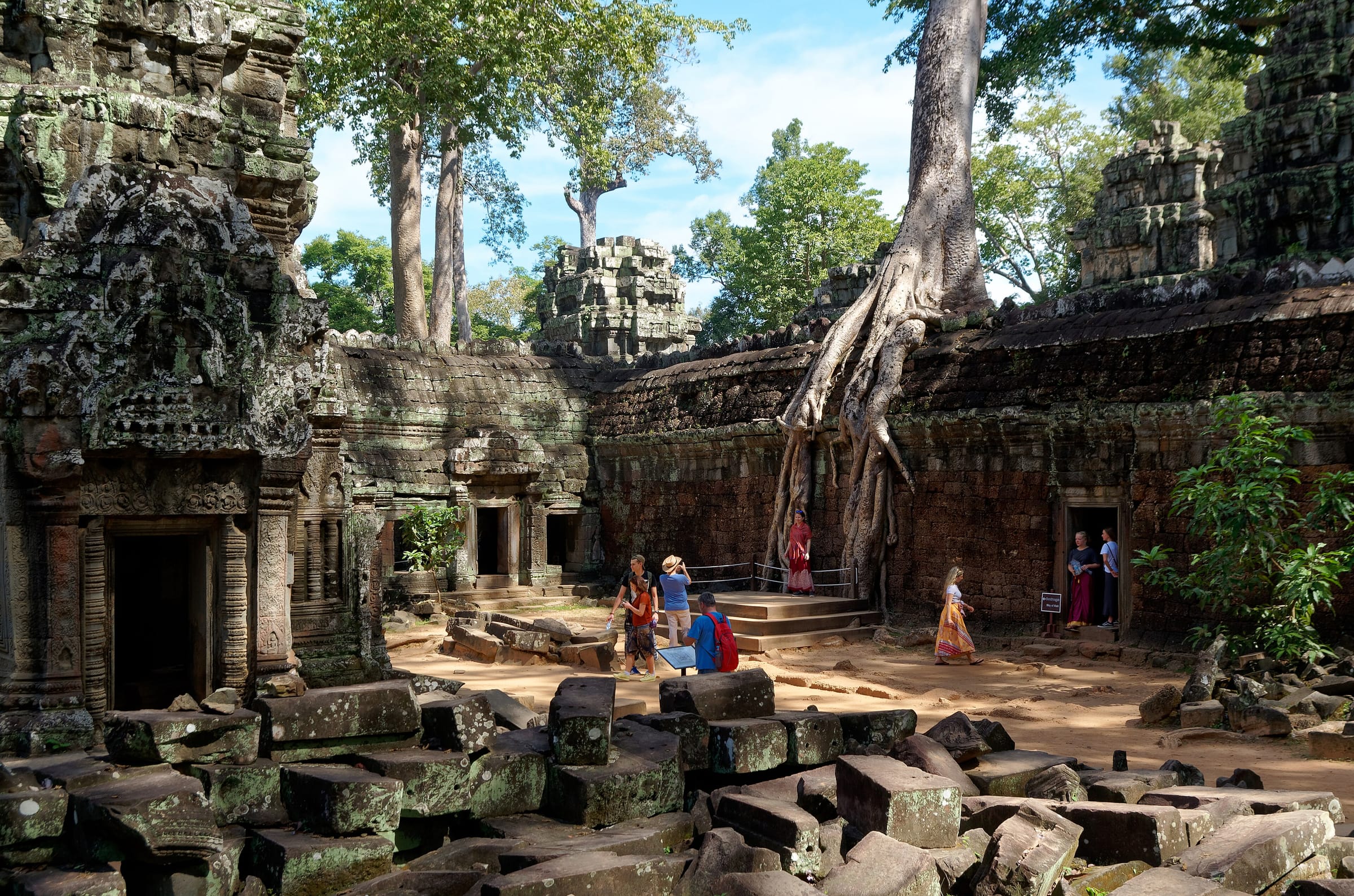
Siem Reap is the base for Angkor Wat and the surrounding temple complex. The temples are the reason you come, and they deserve at least two full days: a sunrise pass at Angkor Wat on day one, then Ta Prohm (the tree-root temple), Bayon, and the smaller circuits on day two. A three-day temple pass covers Angkor, and most people hire a tuk-tuk driver for the day.
The town itself centers on Pub Street and the Old Market area, where restaurants, bars, massage shops, and tour agencies cluster together. The Angkor Night Market and Phare Cambodian Circus (a social enterprise with acrobatic performances) are the best evening activities. Beyond the temples, Tonle Sap floating villages offer boat tours, and cooking classes are widely available.
Siem Reap is well set up for independent travel. Drivers, tours and guesthouses all expect solo visitors. Tuk-tuks are the standard transport, and drivers are generally honest and helpful. The town is small enough to walk around the central area at night. The heat is intense, especially March through May, so start temple visits at dawn and plan for a midday break.
02 of 10
Who this suits
Siem Reap suits women who want a clear purpose to their trip, specifically the temples, with enough infrastructure around it to keep the logistics low-stress. It also works for women who want Southeast Asia without Bangkok-level intensity; the city is small enough to orient yourself in a day.
03 of 10
Common questions
What people ask about Siem Reap, answered with specifics rather than in general terms.
- Can I visit the temples alone without a guide?
- Yes, and many people do. Signs throughout the Angkor complex are in English and French. A guide adds context but is not required for navigation. Hiring a licensed guide for one full day then exploring independently on subsequent days is a common approach.
- What should I actually wear to the temples?
- Covered shoulders and knees are required at Angkor Wat, Bayon, and most other temples. Lightweight linen trousers and a loose long-sleeve shirt are more practical than shorts with a scarf. Sandals are fine but you remove footwear at several shrines, so slip-ons are easier than laced shoes.
- Is it easy to find vegetarian or vegan food?
- More straightforward than most of Southeast Asia. Several dedicated vegetarian restaurants operate around the Old Market, and Khmer dishes like amok can be made with tofu. The word 'mein sach' means without meat in Khmer; it is useful to have it written down.
- How many days do I need for the temples?
- Three days covers the main Angkor circuit, including Angkor Wat, Bayon, Ta Prohm, Banteay Srei, and Preah Khan, without rushing. Two days is doable if you are selective. A one-day visit means choosing two or three temples rather than trying to see everything.
- Do I need to arrange transport before I arrive?
- Not necessary. PassApp works from the airport, and tuk-tuk drivers wait outside arrivals. If you are arriving very late at night, it is worth messaging your accommodation in advance to confirm whether the front desk is staffed or whether check-in is self-directed.
- What is the scam situation with tuk-tuk drivers?
- The most common one is a driver offering to take you to a gem shop or tailor instead of your destination, often claiming the attraction is closed. Use PassApp or Grab with a confirmed destination entered in the app. If a driver deviates, the app records the route.
04 of 10
Where to stay
Each of these has been read rather than listed. The full set is on the stays page.
- Onederz Hostel Siem ReapWomen only
Female-only dorm options are available at this hostel.
hostel · 4.7 from 1890 reviews - The Funky Villagehomestay · 4.6 from 1667 reviews
- Mad Monkey Siem Reap
Women keep coming back for the female-only dorms and how quickly you stop eating breakfast alone. The nightly events mean the common areas stay populated, though if a party hostel near Pub Street sounds like a catch, it is.
hostel · 4.7 from 1661 reviews - The Twizt - Lifestyle Hostel & Hotelhostel · 4.6 from 1128 reviews
- Siem Reap Pub Hostel
Dorms and private rooms on Pub Street, with an outdoor pool, bar and 24 hour reception.
hostel · 4.2 from 1119 reviews - Jaya House River Park Hotel
Women return for the attentive service and the hotel's practise of hiring female tuk-tuk drivers, which puts a known face between you and the city from the moment you arrive. The pool and gardens are genuinely peaceful. No honest catch surfaces in the reviews.
hotel · 4.9 from 1033 reviews · about $291 a night - Babel Siem Reap Guesthousehomestay · 4.8 from 513 reviews
- White Rabbit Hostel Siem ReapWomen only
Located near Siem Reap's Old Market area, walking distance to the main tourist district.
hostel · 4.5 from 473 reviews
05 of 10
What to know
- 01
Temple dress code is enforced
Angkor Wat and most major temples require shoulders and knees covered. Guards check at the entrance. Carry a scarf or sarong in your bag rather than buying overpriced ones at the gate.
- 02
Tuk-tuk drivers may push extras
Some drivers add unplanned stops at silk farms or craft shops where they earn commission. Agree on your route beforehand. A simple no is enough.
- 03
Pub Street gets rowdy late
After 11pm Pub Street shifts from backpacker-social to party crowd. The streets around it stay well-lit and populated. Most solo women head back by midnight without issue.
- 04
The floating village tours vary wildly
Some floating village trips are well-run, others are guilt-trip operations. Ask your guesthouse for a specific recommendation rather than booking from street touts.
06 of 10
Getting around
- 01
Tuk-tuks are the default
Every guesthouse can arrange a tuk-tuk driver for temple circuits. Most drivers will wait for you at each stop. Negotiate a full-day or half-day rate upfront rather than per-trip.
- 02
Grab works here
Grab is available for rides within town and to the temples. Useful for comparing against tuk-tuk quotes. Coverage drops off for more remote temples.
- 03
Walking is fine in town
The central area from Old Market to Pub Street to the river is compact and flat. Pavements are uneven but manageable. Too hot and too far to walk to temples.
- 04
Bicycles for the adventurous
Rental bikes are available everywhere. The road to Angkor Wat is flat and paved. Doable in cooler months but brutal in hot season. E-bikes are increasingly popular.
07 of 10
How the day runs
Temples, sunrise, markets
Serious temple-goers leave at 4:30am for Angkor Wat sunrise. By 7am the outer temples are busy. The Old Market area opens around 8am with coffee shops filling up. Morning is the only bearable time for temple exploration.
Rest, pools, cafes
Almost everyone retreats from the heat. Pool access at guesthouses is common. Cafes with AC become coworking spots. Some people visit the quieter outer temples like Banteay Srei in the afternoon when crowds thin.
Pub Street, night markets, social
Pub Street gets lively from 7pm. The night market near the river has food stalls and local crafts. Most solo travellers end up at the same handful of bars and restaurants, making it easy to meet people.
08 of 10
What to eat
- 01
Fish Amok
Cambodia's signature curry: freshwater fish steamed in a banana leaf cup with a lemongrass-galangal-turmeric coconut mousse.
Mahob Khmer on Sivatha Boulevard. Upscale but not overpriced, and the amok is textbook.
- 02
Lok Lak
Stir-fried marinated beef cubes served on a bed of lettuce and tomato with a tangy lime-pepper dipping sauce and a fried egg on top.
Khmer Kitchen on the Pub Street side streets. Reliable, popular with locals and visitors alike.
- 03
Nom Banh Chok
Fresh rice noodles with a green fish-based curry sauce topped with banana flower, cucumber, and bean sprouts. A breakfast staple.
Morning market stalls and street vendors. Look for women with large pots and a queue forming before 7am.
- 04
Beef Saraman
Slow-braised beef in a dry, aromatic coconut curry with star anise, cinnamon, and cardamom. Cambodian comfort food.
Haven Training Restaurant (social enterprise) or Cuisine Wat Damnak for a fine-dining interpretation.
09 of 10
Neighbourhoods
- 01
Old Market (Psah Chas)
The central grid around Pub Street and the Night Market. Streets are lit, foot traffic runs until midnight, and the density of guesthouses, restaurants, and tour desks makes everything walkable. Loud on weekends, but the noise is from open-air bars, not traffic.
Best for First-timers and anyone who wants everything within a ten-minute walk. - 02
Wat Bo
Residential streets east of the river, named after the 18th-century temple in the middle of the neighbourhood. Quieter than Old Market but well-connected; the main road into town is a five-minute tuk-tuk ride. Several mid-range boutique hotels have set up here because land was cheaper.
Best for Travellers who want a slower pace with easy access to the centre. - 03
Svay Dangkum
The district that holds most of the proper Khmer restaurants locals eat at, as well as the French Quarter's colonial-era buildings on Pokambor Avenue. Less polished than Old Market, but the streets are flat and well-trafficked during the day. The Angkor National Museum is here.
Best for Travellers interested in eating outside the tourist bubble. - 04
Sala Kamreuk
The road running north toward the Angkor complex. Several upscale resorts are set along this corridor, including Amansara and Shinta Mani. Less pedestrian-friendly than central neighbourhoods, but if you are doing full temple days, being closer to the gate saves time.
Best for Travellers prioritizing early temple access over walkable nightlife. - 05
Kandaek / Banteay Chhmar Road
The area around the airport road and Charles de Gaulle Boulevard where newer hotels have clustered. Well-lit main roads, good transport connections, but no neighbourhood character to speak of. Supermarkets like Lucky Mall are here.
Best for Travellers with early flights or those who want a quiet base near amenities.
10 of 10
Local knowledge
The operational detail that is obvious once you are there and impossible to guess before.
- Tuk-tuk drivers outside Angkor Wat at sunset will charge two to three times the PassApp rate; open the app before you negotiate.
- The ticket gates for Angkor open at 5am; arriving at 4:50am means you are in position before the buses from larger hotels.
- Pub Street is pedestrianized at night, which means foot traffic is dense and visible from the main strip.
- Ta Prohm (the tree-root temple) is most atmospheric on weekday mornings; tour groups tend to arrive between 10am and noon.
- Lucky Mall on Sivatha Boulevard has a supermarket on the ground floor where you can buy sunscreen, electrolyte sachets, and water at local prices.
- Most temples require covered shoulders and knees; a light linen shirt and long trousers are better than a shawl, which slips and gets in photographs.
- The Night Market closes by 11pm; Pub Street bars are open until 2am or later, but the two are different atmospheres entirely.